


Launching a new business brings a different kind of excitement. However, securing capital becomes an uphill battle when traditional banks demand consolidated revenue and years of financial history. Many founders face immediate cash constraints. They struggle to qualify for viable alternatives of business loans startup entrepreneurs USA to keep their projects running smoothly.
Finding financing doesn’t have to be a confusing process, as choosing the right business loans startup entrepreneurs USA options provides your company with the exact financial support it needs.
Avoid costly mistakes and protect your equity. Check out an in-depth analysis of business loans startup entrepreneurs USA. Also, compare the best options on the market. Calculate real expenses and fund your company with peace of mind.
What to Understand Before Applying for Startup Credit in the US?
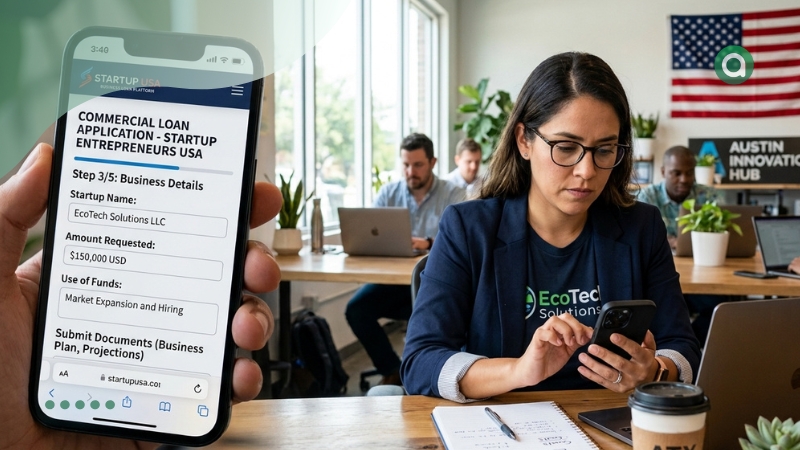
Starting a business in the United States requires much more than just a good business idea.
Financial institutions evaluate very specific financial metrics before releasing funds to new companies.
By opting for debt financing, you maintain full corporate control of your company.
Unlike venture capital funds or angel investors, lenders do not require equity stakes or board seats.
However, it is mandatory to repay the borrowed principal amount plus interest and operating fees.
Understanding the review criteria saves time. It also prevents rejections during the application process. Lenders primarily evaluate four essential pillars:
- Personal Credit Score: Most early-stage founders do not have an established business credit history. For this reason, lenders analyze the entrepreneur’s personal FICO score, generally looking for scores starting at 650 points.
- Annual Percentage Rate (APR): This metric reflects the total annualized cost of the debt, including the base interest rate and all administrative and origination fees.
- Factor Rates vs. APR: Alternative lenders often express costs as factor rates (such as 1.15 to 1.35) instead of the standard annual rate (APR). A factor rate multiplies the total borrowed amount by a fixed multiplier. This often leads to very high effective charges.
- Personal Guarantee: Almost all financial institutions require owners holding 20% or more of the company to sign a personal guarantee. This legal clause ties the founder’s personal assets in case of business default.
Comparison of the 5 Best Business Loans Startup Entrepreneurs USA

Below is a detailed evaluation of the top five financing options currently available.
1. SBA Microloan
The SBA Microloan program, managed by the Small Business Administration, supports entrepreneurs who face barriers in traditional banking channels.
In this case, the U.S. federal government provides funds to non-profit community organizations. They are responsible for evaluating credit and managing the process.
The program offers loan amounts up to $50,000, with an average loan size of around $13,000 in the market.
Repayment terms can extend up to 6 or 7 years, ensuring manageable monthly installments.
Annual interest rates typically range between 8% and 13% (APR), accompanied by minor administrative fees up to 3%.
The ideal target audience consists of micro-businesses, local small shops, service providers, and solo entrepreneurs. These are profiles seeking initial working capital alongside practical mentorship.
2. SBA 7(a) Loans
The SBA 7(a) is the primary commercial loan program in the United States.
Under this scheme, the federal SBA agency guarantees up to 85% of the loan amount provided by partner commercial banks, reducing risk for the financial institution.
Borrowers can access credit lines up to $5,000,000. Meanwhile, the Small 7(a) option handles requests up to $500,000.
As a rule, repayment periods can extend up to 10 years for working capital and equipment purchases. For commercial real estate, terms can go up to 25 years.
Furthermore, interest rates track the benchmark rate (Prime Rate) plus a spread between 2.25% and 4.75%. This results in APRs between 10.5% and 15.5%.
This loan is aimed more at scaling startups with proven revenue. It also serves businesses needing facility renovations or heavy equipment acquisitions. Additionally, it benefits companies looking to purchase commercial real estate.
3. Kiva U.S (Business loans startup entrepreneurs USA)
Kiva U.S. operates as an international non-profit crowdfunding network.
Generally, the platform replaces traditional credit scoring with a community-based social underwriting model.
The program offers loans between $1,000 and $15,000, with repayment schedules spread over 6 to 36 months.
In addition, entrepreneurs benefit from a strict 0% APR interest rate, with no origination fees, monthly maintenance charges, or prepayment penalties.
4. Fundbox
Fundbox is a fintech designed to solve short-term liquidity bottlenecks.
Instead of requiring complex tax returns, the platform assesses business risk directly. It connects to the business bank account and cloud invoicing systems.
Qualified businesses gain access to revolving credit lines from $1,000 to $250,000.
Payments are automatically debited weekly over 12 or 24 weeks. Annual percentage rates (APR) range between 4.66% and 25%, depending on the consistency of company receivables.
5. OnDeck (Business loans startup entrepreneurs USA)
OnDeck is one of the largest digital lenders catering to businesses needing immediate capital injection.
Typically, the platform reports timely payments to major business credit bureaus, helping build corporate credit profile.
Furthermore, the institution provides term loans between $5,000 and $400,000 with terms up to 24 months. Additionally, it offers revolving lines of credit up to $100.000 with 12-month renewal cycles.
However, this speed comes at a high price. APRs usually range from 29.9% to over 60%, plus origination fees between 0% and 4%.
4 Necessary Steps to Prepare Your Credit Application
Following a structured roadmap before filling out forms speeds up processing. It also avoids negative marks on your record. Execute these four steps before submitting your proposal:
- Monitor Your Credit Reports: Check your personal credit score and company commercial profile (with Dun & Bradstreet or Experian Commercial). Correct any registration discrepancies before applying.
- Organize Financial Documents: Gather business bank account statements from the last 3 to 6 months, recent tax returns, and formal business registration.
- Calculate Debt Service Coverage Ratio: Determine your Debt Service Coverage Ratio (DSCR) by dividing net operating income by total projected annual debt payments. Lenders look for ratios equal to or greater than 1.25.
- Define the Allocation of Funds: Draft a concise document detailing exactly where the capital will be invested. Demonstrate how these investments will generate sufficient revenue to cover the installments.
Conclusion
Seeking corporate credit in the United States does not have to be an insurmountable hurdle.
Choosing the ideal option depends on balancing funding speed, total interest costs, and the company’s actual repayment capacity.
Carefully evaluate whether your business stage calls for a zero-cost community microloan, an SBA-guaranteed line, or a faster digital line of credit.
Keep personal finances strictly separate from corporate accounts, compare pre-approved offers, and choose financing that ensures sustainable company growth.
If your business is in its early stages and struggles to qualify for the options presented, we recommend opting for short term loans online US. They have more flexible requirements. Additionally, they are easier to get approved for.